
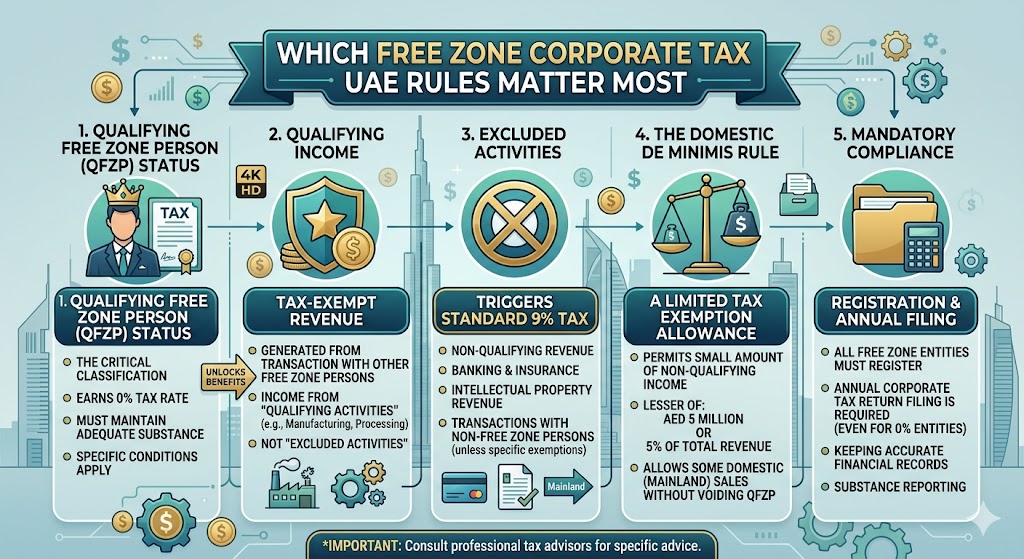
Key free zone corporate tax UAE rules businesses must understand for compliance, qualifying income, and corporate tax filing obligations.
The UAE has built a global reputation as one of the most powerful business destinations for entrepreneurs, investors, and multinational companies. From Dubai to Abu Dhabi, UAE free zones have attracted businesses with investor-friendly regulations, international connectivity, and strong financial advantages. For years, companies established operations believing that free zones would continue offering long-term tax efficiency and simplified business structures.
Today, however, the introduction of free zone corporate tax UAE regulations has transformed the business environment completely. Companies operating across Dubai, Sharjah, Ajman, Ras Al Khaimah, and Abu Dhabi must now understand how UAE corporate tax law affects free zone operations, qualifying income, financial reporting, and compliance obligations.
The reality is no longer as simple as free zone means tax-free. Businesses must now actively maintain compliance under the evolving free zone corporate tax UAE framework to continue benefiting from tax incentives and operational advantages. For modern organizations, understanding these rules has become essential for sustainable growth and financial protection.
The Shift in UAE Corporate Tax Regulations
The introduction of corporate taxation represents one of the biggest financial changes in the UAE business sector. The UAE government introduced corporate tax to strengthen transparency, align with international tax standards, and enhance the country’s long-term economic credibility.
Under the current framework, businesses generating taxable income above the approved threshold may become subject to corporate tax. However, the free zone corporate tax UAE system still allows eligible companies to benefit from a 0% corporate tax rate on qualifying income.
This distinction has created significant interest among investors, startups, and free zone companies seeking clarity on UAE business taxation. Businesses now understand that tax advantages are no longer automatic. Instead, they depend on operational substance, financial transparency, and compliance with Federal Tax Authority regulations.
Understanding Free Zone Corporate Tax UAE Rules
The concept of free zone corporate tax UAE revolves around maintaining qualifying free zone status. Businesses operating inside UAE free zones must meet specific conditions established by the Federal Tax Authority to preserve tax benefits.
A company must demonstrate genuine economic activity within the free zone jurisdiction. This includes maintaining active operations, employees, commercial functions, and management activities inside the UAE. Businesses operating as paper-only structures may struggle to meet economic substance requirements under UAE corporate tax law.
The classification of income has also become one of the most important aspects of free zone corporate tax UAE compliance. Certain types of qualifying income may remain eligible for preferential tax treatment, while other mainland-related business activities could become subject to the standard corporate tax rate.
Because of this, companies operating across multiple jurisdictions inside the UAE must carefully review their operational models and revenue structures.
Why Qualifying Income Matters
One of the most complex parts of free zone corporate tax UAE regulations involves understanding qualifying income. Many businesses incorrectly assume that all free zone revenue automatically qualifies for tax exemptions. In reality, UAE tax compliance now requires businesses to assess every revenue stream carefully.
Income generated from approved free zone transactions may continue benefiting from tax advantages. However, mainland transactions and non-qualifying activities may receive different tax treatment under UAE corporate tax regulations.
This has created operational challenges for businesses involved in consulting, logistics, e-commerce, digital services, trading, and international business operations. Companies must maintain accurate financial records, detailed invoices, and organized accounting systems capable of supporting tax classifications during audits and compliance reviews.
The growing complexity of free zone corporate tax UAE regulations has made professional tax planning more important than ever before.
Financial Compliance Is No Longer Optional
The introduction of free zone corporate tax UAE requirements has significantly increased the importance of financial reporting and bookkeeping across the Emirates. Businesses can no longer rely on informal accounting systems or incomplete financial documentation.
Today, companies are expected to maintain audited financial statements, transparent reporting structures, and accurate bookkeeping records that support UAE corporate tax filings. Financial transparency now plays a major role in determining compliance status and protecting tax benefits.
Poor accounting practices can expose companies to serious risks, including penalties, compliance investigations, delayed filings, audit complications, and additional tax liabilities. Businesses that fail to maintain accurate records may also struggle to prove qualifying free zone person status under UAE tax law.
Because of this, many organizations are investing heavily in accounting support, tax consultants UAE services, and compliance management systems to strengthen operational stability.
Corporate Tax Registration UAE Requirements
Corporate tax registration UAE procedures have become mandatory for eligible businesses operating inside the country. Companies must register with the Federal Tax Authority according to the deadlines established under UAE corporate tax law.
The registration process typically requires detailed business information, trade license records, ownership documents, financial details, and operational data. Many businesses underestimate the importance of accurate registration, often assuming free zone companies are automatically exempt from these obligations.
Incorrect submissions, delayed registration, or incomplete documentation can create unnecessary compliance risks. This is why businesses are increasingly seeking professional support to manage free zone corporate tax UAE registration and reporting obligations properly from the beginning.
Common Free Zone Corporate Tax UAE Mistakes
As businesses continue adapting to the UAE’s evolving tax system, several common mistakes are creating avoidable compliance problems. One of the biggest issues involves misunderstanding qualifying free zone income. Many companies still believe all free zone activities automatically remain tax-free, even when conducting mainland business operations.
Poor bookkeeping is another major concern. Businesses that fail to maintain accurate accounting systems often experience complications during corporate tax return filing UAE procedures and financial audits. Incomplete records increase compliance risk and weaken financial transparency.
Transfer pricing compliance has also become a growing issue for businesses conducting transactions with related entities or international subsidiaries. UAE transfer pricing regulations require proper documentation that aligns with international OECD standards.
Another common mistake involves delaying UAE corporate tax registration. Businesses postponing compliance may expose themselves to administrative penalties and unnecessary operational disruptions.
These challenges demonstrate why free zone corporate tax UAE compliance should never be treated as a simple administrative task.
The Importance of Professional Tax Planning
The growing complexity of free zone corporate tax UAE regulations has changed how businesses approach financial management and operational planning. Corporate taxation is no longer only about filing tax returns. It now involves strategic decision-making, compliance monitoring, and financial risk management.
Professional tax advisors help businesses evaluate qualifying free zone person eligibility, manage UAE tax filing requirements, maintain compliance documentation, and structure operations efficiently. This guidance helps organizations reduce unnecessary tax exposure while strengthening long-term business stability.
Strategic tax planning also allows companies to improve financial transparency, protect operational profitability, and maintain stronger investor confidence. Businesses that approach free zone corporate tax UAE proactively are far more likely to remain competitive in the evolving UAE market.
Why UAE Free Zones Still Matter
Despite the introduction of corporate taxation, UAE free zones continue offering exceptional advantages for entrepreneurs and international companies. The UAE remains one of the world’s strongest commercial hubs, supported by advanced infrastructure, global connectivity, investor-friendly regulations, and strategic geographic positioning.
The purpose of free zone corporate tax UAE regulations is not to eliminate business advantages. Instead, the framework strengthens the UAE’s position as a transparent and globally trusted financial center. Companies that adapt effectively can still benefit from substantial tax efficiency while operating inside one of the world’s fastest-growing economies.
Businesses that prioritize compliance, operational transparency, and accurate reporting will continue finding strong growth opportunities across UAE free zones.
Final Thoughts
The introduction of free zone corporate tax UAE regulations marks a major transformation in the country’s business environment. While free zone companies can still benefit from attractive tax incentives, maintaining those advantages now requires proper planning, accurate financial reporting, and continuous compliance with Federal Tax Authority regulations.
Businesses that understand qualifying income, maintain audited financial statements, complete UAE corporate tax registration correctly, and implement strategic tax planning will be better positioned for long-term success.
As UAE corporate tax laws continue evolving, companies must remain proactive, financially organized, and professionally supported. With the right strategy and expert guidance, businesses can confidently navigate the changing landscape of free zone corporate tax UAE while protecting profitability and building sustainable growth across the UAE market.
About the Author